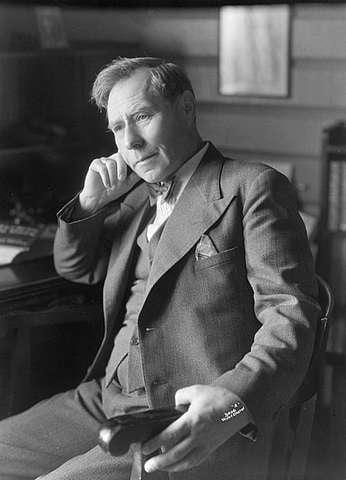
author
Olav Duun
1876–1939
A major voice in Norwegian fiction, Olav Duun drew on the landscapes, speech, and traditions of coastal Trøndelag to explore family, conscience, and the struggle between tradition and change. His six-volume Juvikfolke remains his best-known achievement.
1 Audiobook

The trough of the wave
by Olav Duun
About the author
Olav Duun (1876–1939) was a Norwegian novelist and teacher, born on the island of Jøa in Namdalen. He grew up in a farming and fishing family and spent part of his early life working in the fisheries before studying at Levanger teachers’ college. In 1908, he married Emma Møller and moved to Botne in Vestfold, where he taught until 1927.
Duun published around 25 novels, four collections of short stories, and two children’s books between 1907 and 1938. He wrote largely in Nynorsk and used the language and cultural world of his home region as the foundation for stories about rural communities, moral conflict, human resilience, and social change.
His major works include the six-volume Juvikfolke, published from 1918 to 1923, the Medmenneske trilogy, and the late novel Menneske og maktene. He is widely regarded as one of Norway’s leading twentieth-century novelists.