author
Jean Terrasson
1670–1750
A French priest, scholar, and novelist, Jean Terrasson brought the intellectual debates of the Enlightenment into lively works of criticism, philosophy, and fiction. His best-known book, Sethos, imagined ancient Egypt with such influence that it later helped inspire Mozart’s The Magic Flute.
1 Audiobook
About the author
Jean Terrasson was born in Lyon on January 31, 1670, and died in Paris on September 15, 1750. An Oratorian priest and accomplished Hellenist and Latinist, he taught Greek and Latin philosophy at the Collège Royal from 1721. He also belonged to the Académie des Inscriptions and was elected to the Académie française in 1732.
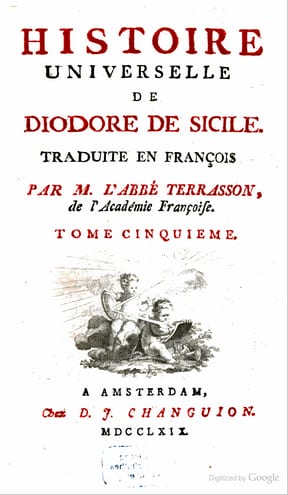
Terrasson supported the “Moderns” in the famous literary dispute between the Ancients and Moderns. In his Dissertation critique sur l’Iliade (1715), he argued that modern learning and literature could surpass the achievements of classical antiquity. He also wrote on philosophy, mathematics, and public finance, and translated Diodorus Siculus into French in a seven-volume edition published between 1737 and 1744.
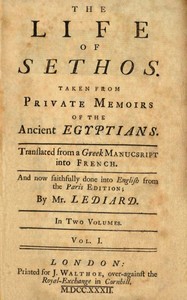
His most memorable work is Sethos, histoire ou vie tirée des monumens anecdotes de l’ancienne Égypte (1731), a philosophical and educational adventure about an Egyptian prince. Presented as a translation from an ancient Greek manuscript, the novel blended travel, mystery, ritual, and moral instruction, and later became one of the sources associated with Mozart and Schikaneder’s The Magic Flute.