- Listenly
- Browse
- Authors
- Irving Babbitt
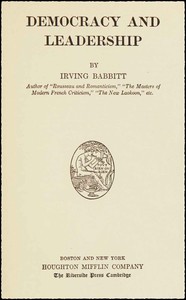
- Democracy and leadership
Chapters
15 totalDEMOCRACY AND
PREFATORY NOTE
INTRODUCTION
CHAPTER I
CHAPTER II
CHAPTER III
CHAPTER IV
CHAPTER V
CHAPTER VI
CHAPTER VII
Description
This thoughtful work examines democracy not merely as a system of government, but as a moral and philosophical challenge. Beginning with the limits of economic explanations, it traces political questions toward deeper concerns about human nature, self-control, tradition, freedom, and the standards by which societies should be led. The discussion is grounded in the tension between inner discipline and external authority, asking what happens when popular power becomes as absolute as any monarchy.
A central focus is the contrast between Rousseau’s radical democratic vision and the conservative moral imagination associated with Burke. Along the way, the book considers democracy’s relationship to imperialism, liberalism, civilization, and the changing balance between Europe and Asia. Its arguments are historical and wide-ranging, drawing on classical thinkers as well as modern political debate, while challenging the assumption that progress and benevolence naturally follow from dismantling established institutions. Listeners interested in political philosophy, intellectual history, and the ethical foundations of public life will find a serious invitation to reconsider what genuine freedom and responsible leadership require.
Details
Language
en
Duration
~10 hours (578K characters)
Release date
Sep 24, 2026
Rights
Public domain in the USA.
About the author

Irving Babbitt
1865–1933
A leading voice in early 20th-century American literary criticism, he championed disciplined reading, classical learning, and moral judgment. His defense of the humanities helped shape the movement known as New Humanism.
View all booksYou may also like

Rousseau and Romanticism
by Irving Babbitt